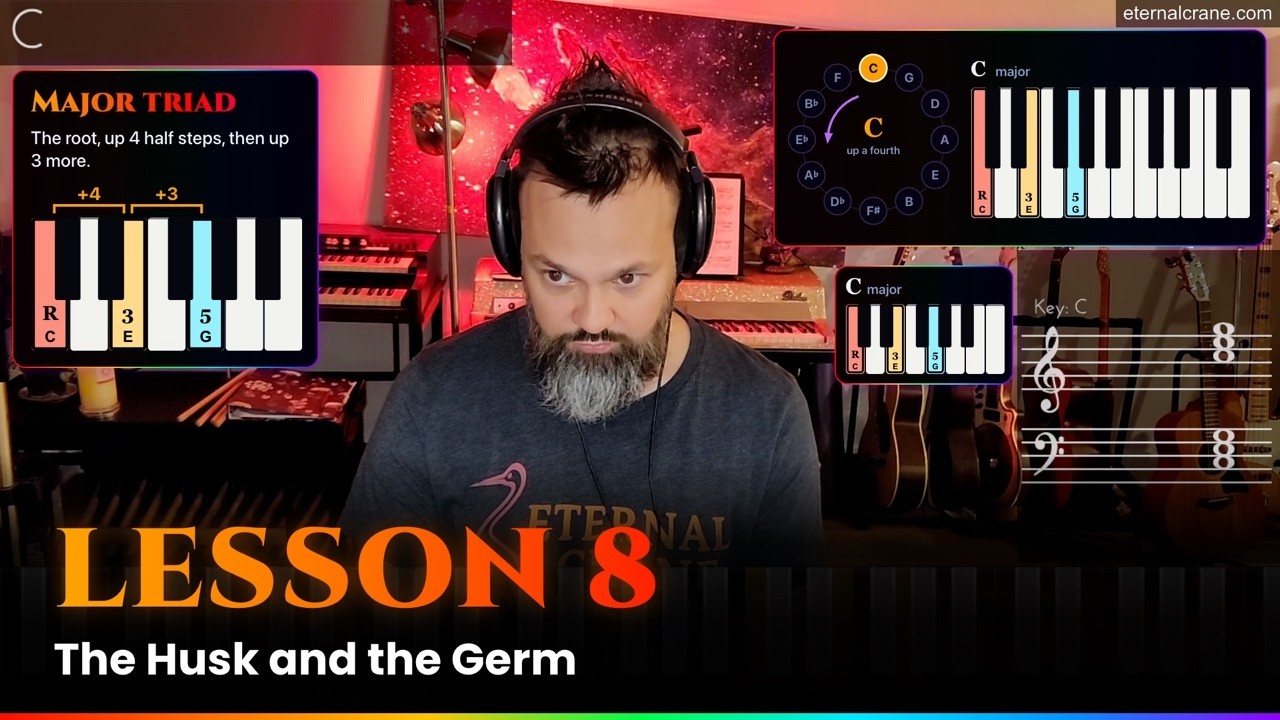
Lesson 8: The Husk and the Germ
#Augmented chords#Circle of fifths#Diminished chords#Half steps#Intervals#Triads#Happy appearances#Interfaith#Letting go#Mistakes#Rumi
The eighth lesson of Thirteen Weeks of Music & Spirit, closing week 4. Its theme is the husk and the germ. The husk is the tough outer layer that protects a seed while it grows; the germ is the living embryo at the seed's core, from which a new plant sprouts.
joEy's teaching: "The religion and faith system is the dead husk. I seek the germ." On an interfaith path we don't seek dogma, a structure or an institution, or do things only because others did.
The sacred part of us lives deep inside, and that is our germ. Churches, books and faith systems are useful when they nourish that inner seed, but they are not the seed, and they should never shelter us from real spiritual growth.
Eight short teachings come up on screen through the lesson: the husk that keeps the seed, letting go, the kernel, breaking open, and the seed that grows. He recommends reading Rumi and the Muslim mystics, early voices of the interfaith path. His cat Birmingham drops in twice: a mistake is always OK, a happy appearance, and music is no place to compete.
Quoted on screen, and three of them read aloud: Mahmud Shabistari, Gulshan-i Raz, couplet 582, translated by E. H. Whinfield; the Buddha, the Alagaddupama Sutta (MN 22), translated by Thanissaro Bhikkhu; Lao Tzu, Tao Te Ching, chapter 38, English version by Ursula K. Le Guin; Rumi, Masnavi IV 3281 and 3283 and III 1387, translated by R. A. Nicholson; Meister Eckhart, Sermon CII, "Honour Thy Father", translated by C. de B. Evans; John 12:24, King James Version.
The music is the four kinds of triad, three notes stacked in thirds. A major triad is a root, a major third (four half steps up) and a fifth (three half steps more): in C, C E G.
A minor triad lowers the third: C E flat G. A diminished triad lowers the third and the fifth: C E flat G flat. An augmented triad raises the fifth: C E G sharp.
joEy teaches the diminished and the augmented as first-class citizens, with sounds of their own, not as extras to the major and minor. He plays each kind in all twelve keys: round the circle of fifths one way and then the other (C, F, B flat and on in fourths; C, G, D and on in fifths), then chromatically, up and down by half steps, where every note moves one key and the shape carries over. Take them slowly; arpeggiating, playing a chord's notes one at a time, helps.
When a mistake comes, name it: he plays B flat over A flat, a major second, where he meant a minor third, and moves to the chord he meant. He builds the augmented triads from the root, going down from B: find the major third first, then the augmented fifth.
The recap takes C as the study key, its four triads with their steps in half steps, and asks you to do this in all 12 keys. Last, his cat Twiddle calls listening time: hear with your ears what is major, minor, diminished and augmented, since listening is more important than seeing.
Chapters
View allTranscript
Follow along using the transcript: 1,713 words in 8 chapters.
Show transcriptAsk joEy
A question about this lesson goes straight to joEy, and it’s always free.
Ask your questionIn this video
- 0:00:12The Husk and the Germ
- 0:04:29The Major Triads
- 0:07:17The Minor Triads
- 0:09:34The Diminished Triads
- 0:14:01The Augmented Triads
- 0:17:41Build It Off the Root
- 0:19:21The Recap
- 0:20:02Listening Time
The Husk and the Germ
0:00:12 Hey, it's joEy from Eternal Crane. This is lesson 8 of 13 weeks of music and spirit. This concludes week 4. Congratulations if you've watched this long. The lesson today is about the wheat and separating the husk from the germ. The husk is the tough, fibrous, inedible outer layer that protects the seed while it grows. The germ is the nutrient-dense embryo at the core of the seed which a new plant sprouts. The spiritual teaching today is to separate our own husk and germ.
0:01:14 The religion and faith system is the dead husk. I seek the germ. This means that as an interfaith being, we don't seek dogma. We don't seek a structure. We don't seek an institution. We don't follow something just because other people did. We don't do things that other people do because that's how it's done. We have a more sacred part of us that lives deep inside us. That is our germ. The faith systems are useful to find your inner spiritual seed, but they are not the seed.
0:02:04 So I encourage anybody on the spiritual path to practice throwing away the husk. Throw away the religion. If it comes to it, throw the book away. If the book is too important for you, throw the institution away. It's okay to follow your spiritual path at home. It's okay to deviate from what was written a thousand years ago. It's okay to do what others don't think you should do. You are not an X or a Y or a Z. You're not a Christian. You're not a Tao. You're not a Muslim.
0:02:55 You are a seed. You're a spiritual being. You're a soul. Those faith systems, again, they can be useful. And I study many faith systems, but that's not the end point. Just because I'm a Christian doesn't mean that I'm a good person and it doesn't mean that I'm following the sacred path. People are into the husk. They follow the fibrous shell and they actually use that to protect themselves from getting into the core of what's happening in their soul, in their heart, in their minds.
0:03:38 Do not use a faith system or a religion to insulate yourself from actual growth. See the institution, the churches, the books. See that as something that is serving you and nourishing your inner seed. Without a husk, the kernel ripens not. From external knowledge grows the sweet knowledge of faith. Whatever on your path is growing your faith, you know that it's serving you. You know that it's serving your seed. So think about this teaching. It's a challenging teaching. It challenges us to not use our own faith system to prevent our own spiritual growth.
The Major Triads
0:04:29 Now, the lesson today is the triads. We're going to go through the circle of fifths. We're going to do the majors first. Take these as slow as you need to. Take your time and enjoy them. Listen to how they ring. You're welcome to arpeggiate them. That can be very helpful when you're learning. So I just went one direction of the circle. Now I'm going to go the other way.
0:05:27 Again, take your time. You're learning as I am because I'm always learning. Some can be trickier than others. So you're welcome to, once again, arpeggiate. It also can just sound very musical and nice. So I went both directions of the circle.
0:06:09 Now we're going to go by half steps. This can be quite useful when you're learning. It's good because it's easy for you to figure the shapes out because you move each note by a half step. So the shape carries over. You get a shortcut, a mental shortcut.
0:06:42 And the use of that is it's still training your body to be in these shapes. So it's still useful, quite useful. And if you go up, you should go down. So that's chromatic. So we just went through these three different ways.
The Minor Triads
0:07:17 And next we'll do the minors. So we're going to go through the circle again. We're going to do the same thing with minors. Take your time. I think I made a happy appearance there. Just allow yourself to learn. As long as you've been playing, it's always new learning. I'm going to go the other way.
0:08:05 Adding a slight arpeggio. Just because I think that sounds quite lovely. If you have to stop and think about it, let yourself stop and think about it. Nothing wrong with that. You have all the time in the world. You're going to go chromatic. Stay calm in your body. Stay relaxed. There's no prize for doing them quickly.
0:09:07 Best way is whichever way gives you the most personal enjoyment. Just listening to these wonderful sounds. That was a happy appearance.
The Diminished Triads
0:09:34 Now, where I differ as a teacher is I teach the diminished and the augmented as first-class citizens. I don't believe that we should teach them as secondary to the majors and minors. They're not complementary. They're their own first-class citizens. Their own sounds. So we're going to do the diminished now. So we're going to do them up this circle. For many players, these are new. New-ish. So take your time.
0:10:34 The reason we treat diminished as first-class citizens is because they offer a unique tonal color, tonal palette. They also expand our knowledge of triads. I'm going to go in the other direction. Remember to keep breathing as you're doing these. And if you have to pause for a moment, just pause. If you need to stretch out, just stretch out. This should not be anxiety-provoking. This should be peace-provoking. The best way to find peace when you're playing is to enjoy the sound. And then we're going to go by half steps. This is fun. Keep your hands relaxed. It's okay to go down like this. I'm doing a little... You can make a musical.
0:12:22 Now, if you make a happy appearance, go ahead and notice what you played. Oh, I see. I played a B-flat over A-flat. This is a major second. And what I meant to play was a minor third. So, I'll make the adjustment. Ah, I see. Now I found the chord. So, if you make a happy appearance, always name it. Get comfortable with your, quote, mistake. And then learn how to move it where you were trying to go. If you get stuck sometimes, go ahead and just play the note a few times.
0:13:14 Breaking open, inasmuch as its kernel had filled them and had reached maturity, the rinds became very thin and burst. Ah, in many ways we outgrow our faith systems, don't we? Hmm. I recommend reading Rumi and the Muslim mystics. They talked very early about the interfaith path. And they, many of them said that I follow all of them and none of them. So, that's the diminished.
The Augmented Triads
0:14:01 Now we're going to do the augmenteds. Again, these are first-class citizens. Don't treat them as exotic because these are wonderful sounds. This time I went up with G first. So, I'll do the other side. Take your time if you don't know these very well.
0:14:30 Sometimes it can be very slow as you're learning these. I think these just have an incredible sound to them to hear these more and more. And these show up a lot in extended jazz chords. They show up as chords with raised fours, things like that. So, where am I in my E-flat? You can see they're making me think a little bit. That's good.
0:15:30 Okay, I'm going to go back down. This time I'm going to go to F. So, get a feeling for these shapes. They're almost like a major triad on the bottom, but they just have a very unique pattern happening on top. These can make your playing sound much more sophisticated because you don't get to hear these as much.
0:16:13 Especially if you linger. If you linger on these. Breaking open. You must break the outside to let out the inside. To get at the kernel means breaking the shell. I'm going to have to watch this whole lesson back. A little thought provoking. And then we'll finish it by going up and down. So, if you get some anxiety, just relax. It's going to be okay. Try to find those major thirds first. And you're even welcome to build the triad.
0:17:15 And then just move that top note up a half step. Again, there's lots of resources to see how to build these. I wouldn't say this is a complete course. It's not my intention. Nothing is ever completed in music. I'm just here to show you some new ideas.
Build It Off the Root
0:17:41 Now, I'm going down. It's helpful to build it off the root. So, I'm at C now. So, oh, I must build off the new root. The new root is B. I'm going to find my B triad. My major third. So, that's one way to do it. Is find your major third first. And then find your augmented fifth.
0:18:18 And your major third. Augmented fifth. And you could even do that the whole way down. And it's good to name it in your mind. I'm going to find the F sharp major third. And then add the fifth. That type of procedural thinking can help you do something that you've never done before.
0:18:51 You'll also get to train your ear to hear the intervals. And you may do it like this for a week. And then it could be four weeks. It could be a whole year. And then after a year, through a whole year, you'll find another pattern to break it down. So, that's how.
The Recap
0:19:21 So, let's just recap. We did the major triads. The minor triads. The diminished triads we did do. And the augmented triads. We did four categories of triads. And we did them through the circle of fifths in both directions. And then we did it chromatically in both directions. So, get those in your hands. And then it'll be much easier to pull them out when you're improvising. So, I hope that was helpful. I hope you liked the spiritual lesson.
Listening Time
0:20:02 I'm going to try to play with some of these.
Thirteen Weeks of Music & Spirit Eternal Crane · 8 / 9
- 1
 20mOne NoteOctober 6, 2026
- 2
 17mLet Music Play YouOctober 8, 2026
- 3
 19mLive an Empty Life, Discovering LydianOctober 13, 2026
- 4
 20mWrong Notes or Happy AppearancesOctober 15, 2026
- 5
 23mNot Knowing Anything is the Best Place to BeginOctober 20, 2026
- 6
 22mThe Mountain, 12-Key BluesOctober 22, 2026
- 7
 21mThe Human Divinity SignalOctober 27, 2026
 22mThe Husk and the GermOctober 29, 2026
- 9
 24mEvery Stranger BelongsNovember 3, 2026
Up next
- 24m
 Lesson 9: Every Stranger BelongsEternal Crane
 23mRaised Fives and the Whole ToneEternal Crane
 10mPillars of CreationEternal Crane
 15mImprovising Seventh Chords Through the KeysEternal Crane
 1h 17mJapanese MelodicaEternal Crane
 24mBlue Falling Ice GlaciersEternal Crane
 22mShou Yi 守一Eternal Crane
 33mThere Will Be Flowers Next YearEternal Crane