
Lesson 2: Let Music Play You
#Half steps#Triads#Tritone#Chuang Tzu#Compassion#Forgiveness#Mistakes
The second lesson of Thirteen Weeks of Music & Spirit. joEy's talk, Nobody at the Wheel, is about forgiving mistakes, your own and other people's. He owns his mistakes, and he also sees the pain and fear that drove him, which he couldn't see then.
Chuang Tzu's empty boat makes the same point: no one gets angry at an empty boat that drifts into them. People are still responsible, but compassion comes first.
Quoted: Chuang Tzu, chapter 20, translated by Herbert A. Giles (1889).
The music is stacking triads: he holds C in the bass and plays three-note chords above it. A G triad on top makes C major 7 sus 2; an F sharp triad, a tritone away, makes C7 with a flat 9 and a sharp 11. Then he reaches a target note from a half step above and below.
Chapters
View allTranscript
Follow along using the transcript: 1,821 words in 5 chapters.
Show transcriptClips
- The Empty BoatNobody is in the boat.On YouTube Shorts · On TikTok · from 0:03:58
- Stack a Triad Over CStack any triad over C.On YouTube Shorts · On TikTok · from 0:06:17
- Nobody Has to KnowNobody has to know.On YouTube Shorts · On TikTok · from 0:11:35


Ask joEy
A question about this lesson goes straight to joEy, and it’s always free.
Ask your questionIn this video
- 0:00:08Welcome to Lesson 2
- 0:01:06Nobody at the Wheel
- 0:06:05Stacking Triads Over C
- 0:12:34A Half Step Above, a Half Step Below
- 0:16:08Thanks and Goodbye
Welcome to Lesson 2
0:00:08 This is a place where we're friends and everybody's a musician because everybody has ears and everybody vibrates. So if you just like to listen, you're welcome here. And if you want to play, you're welcome. Beginners, intermediates, not sure I would say I'm advanced. I don't think I'll ever say I'm advanced. So here we are today on Lesson 2. As always, the format is the same. 20 minutes, hopefully digestible. The welcome, spiritual talk, music lesson.
0:00:46 We always end with at least a few minutes of improvisation and then open room for questions and belonging. Community is for everybody and you don't have to earn your way.
Nobody at the Wheel
0:01:06 So the spiritual lesson for today, I've learned this one in my own life. I've looked back on the mistakes that I've made and that's a long list. The list of mistakes that I've made goes all the way from my toes down to my nose. Everybody makes mistakes and lots of mistakes and we're going to continue to make them. So when I look back on my mistakes, I can take responsibility for them and I do. I did them. Nobody else did them for me.
0:01:49 But I also balance that with compassion. When I look back at my mistakes, especially my bigger mistakes, I can see that I was struggling as a person. My life was on fire. I didn't have the community that I needed to keep me safe. The society wasn't keeping me safe. Maybe I didn't have the family support to keep me safe at that time. I didn't have the grace at that time. I didn't have the resources. And my mistakes, there was an unconscious force that was working.
0:02:35 There was suffering. There was challenge. There was difficulty. I couldn't see it all right in front of my face. I was only able to see what I was actually struggling with years later. So when I look back at my mistakes, I'm allowed to forgive myself because I was sitting in the passenger seat of the car. And my analogy is driving the car at, let's say, 103 miles an hour. Yes, joEy was in the car driving at 103 miles an hour, making many mistakes, but he actually wasn't behind the wheel.
0:03:19 And what I mean by that is he was blind to all of the forces that were working, all of the pain and the agony and the suffering and the terror, the anxiety. Those forces that he could not control led him into a car so he could drive that quickly. So yes, joEy's responsible. And yes, he was in the car. But when I look at my spiritual life, there was nobody driving the wheel. So this is a teaching from Buddhism. It's a teaching from Taoism.
0:03:58 People are responsible, but they're not in control of their actions. Chuang Tzu talks about two boats on the river or the lake. And you're in your boat and another boat blows into you and there's nobody in the boat. You wouldn't be upset at all. You'd say, well, that's just a boat that ran into me. And you would push the boat away and keep paddling and move on. But the second that there's another person in the boat that runs into you, now you find yourself shouting and cursing.
0:04:41 How could you do this? So the teaching here, learn to see that nobody is behind the wheel. Nobody is in the boat. I'm not saying people aren't responsible. I'm not saying that there's not justice. But I'm saying that compassion comes first. There is nobody to blame. And that's how you can bring compassion and forgiveness and understanding to yourself and to other people.
0:05:18 So go through life with an empty boat. Of course you try your best. Of course you try to prevent mistakes before they come. That's part of a spiritual path. And of course you protect yourself from others who are making mistakes. That's keeping yourself safe. But in a deeper sense, go through your life with an empty boat. See others as there's nobody behind the wheel. There is nobody there. This is all the process where we're all trying to do the best that we can.
0:05:53 We're all trying to grow. And we all make mistakes and we're all moving forward. I hope that helps you. It can help you find forgiveness.
Stacking Triads Over C
0:06:05 The lesson today, we are stacking triads. Pretty basic. You know joEy, he's pretty simple-minded. So we just stack triads. Pretty basic. That's it. So we'll play root. I'm playing C as a root. And then just go ahead and pick some triads. I'll pick G. And you're welcome to study what this creates. This creates a C major 7sus2. Wonderful. You could try another one. This is F over C because C actually belongs in F. I just made an F triad on the right hand.
0:06:52 Let's pick some more interesting ones. And let's make a little pattern. We're going to go flat 7, 5, flat 3, 1. So I'm going to do flat 7. And I'm doing just some inversions. 5. This is beautiful. Flat 3, 1. And then if you do it in your right hand, you know what to do. You do it in your left hand as well. So flat 7, 5, flat 3, 1. I'm going to play a minor. That's just a minor lick. And I'm going to play it again in the bass because I found that really quite nice.
0:07:47 I'll play another minor, C minor in the left hand. And I'm going to play it in the right hand to hear that again. I'm going to go down. I went down two octaves that time. So you see just by taking some of these triads and stacking them, you can actually go quite a lot of places. Here's one. Do the tritone. Play C in the left and then play a tritone up top. And this gives you these dominant chords with flat 9s and raise 11s, sharp 4s.
0:08:35 And you can change, you can swap them, let's say. And this is just breaking, breaking that tritone. So you can create a lot of sounds just by creating triads. This one here, this one here is D over C. You could go through the diatonic triads. So lots of possibilities. If you're playing in the key of F, go ahead and just put B flat on, which is a 4. I'm just playing the 4 chord. I'm still in the key of F. Chordie will show you at B flat and that's great.
0:10:06 I can also play it over C. It's going to show that you're in the key of F. But in my mind, my simple mind, I am still in the same key of F. So anytime you're playing a piece, if I'm playing in B flat, and I just want to add a little bit of color, I just play the 4 chord or the 5 chord over the triad, the root triad, just to add a little bit of color.
0:10:52 So try stacking triads and take risks, take danger. I only found these. I only found these by playing around. In this case, it was triad on top. That's a, this is a major triad built off the major 7. Flat 5, 4, flat 3. This time I'm going to go flat 7, 1. So you take a pattern and you learn these.
0:11:39 This is a great, this time I ended on a flat 2. This is a great way to add a little bit of color. So I'm just playing C minor in the bass, and I want to add some color. Nobody else in the band has to know that you changed keys. Nobody has to know what you just did. Use that when you have a moment to speak with the listener. So go ahead and pick random triads and see how they sound.
A Half Step Above, a Half Step Below
0:12:34 And then I want to show you, with this trick you can, let's go ahead and go down. Instead of going to C to end the line, I'm going to go to the major 7, and then I'm going to resolve it. So let's say my target is C. I'm actually going to go down a half step below it. Half step, and then resolve. You can do it in the left hand, and I'm going to go half step above, and then resolve it. Half step above, resolve it. So if I'm playing C blues, color, I just built a triad on top.
0:13:35 That's a half step higher, resolve it. You can even go half step above, half step below, root, or target. I'm playing the C blues. So what you got from this is you got to play all these dark notes, and you got to resolve it, and you did not change your key. You didn't change what the music conceptually is doing.
0:14:18 These are just random triads. A lot of them are half steps, half steps out. There's the tritone again. So you can go ahead and play a tritone, lick, play, triad. If I want to get to the triad, I want a half step below, half step above, and it on target. This is a dissonant target, so it's not going to sound resolved. If you want more of a resolve sound, you can resolve to the four. You can resolve to the five. And of course, the strongest, you can resolve to the one.
0:15:10 Do them in both hands. See, this is a good one. There's a lot of storytelling, a lot of storytelling potential. So you can go quite far with these triads. Lesson's about to end. I'm going to do the triads. Down the whole tone scale. Let's do that one more time. Is that a nice? Down the whole tone scale. How about that? So those are some ideas that you can stack. I hope this helps you be a professional stacker.
Thanks and Goodbye
0:16:08 If you have any questions on this lesson or anything, go ahead and write me at eternalcrane.com. Questions are always free. You can join the Discord. It's also free. Share your music you're playing. Ask a question there. Keep with this course. This course is going to go until the end of the year. I think it'll add a lot of peace to your life and teach you some improvisational and music theory ideas. And if you want me to learn a piece, and if you'd like to hire me, please reach out.
0:16:42 I can help you with music, training, coaching, studio building, spiritual growth, shamanic reading, you name it. If you think I can help you, send me a message. So that's it. I will see you next week, Tuesday on the 13th. So be well and take care of yourself. Bye-bye.
Thirteen Weeks of Music & Spirit Eternal Crane · 2 / 9
- 1
 20mOne NoteOctober 6, 2026
 17mLet Music Play YouOctober 8, 2026
- 3
 19mLive an Empty Life, Discovering LydianOctober 13, 2026
- 4
 20mWrong Notes or Happy AppearancesOctober 15, 2026
- 5
 23mNot Knowing Anything is the Best Place to BeginOctober 20, 2026
- 6
 22mThe Mountain, 12-Key BluesOctober 22, 2026
- 7
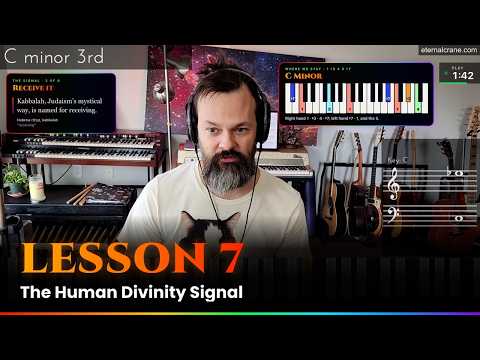 21mThe Human Divinity SignalOctober 27, 2026
- 8
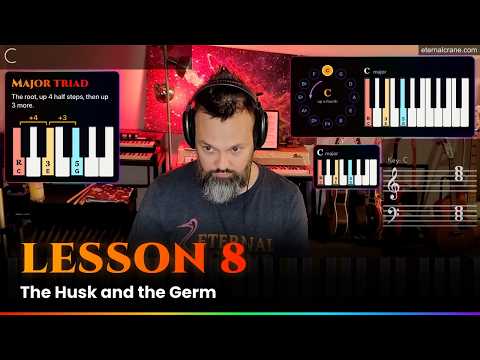 22mThe Husk and the GermOctober 29, 2026
- 9
 24mEvery Stranger BelongsNovember 3, 2026
Up next
- 19m
 Lesson 3: Live an Empty Life, Discovering LydianEternal Crane
- 20mLesson 4: Wrong Notes or Happy AppearancesEternal Crane
- 23mLesson 5: Not Knowing Anything is the Best Place to BeginEternal Crane
 1h 17mJapanese MelodicaEternal Crane
 15mImprovising Seventh Chords Through the KeysEternal Crane
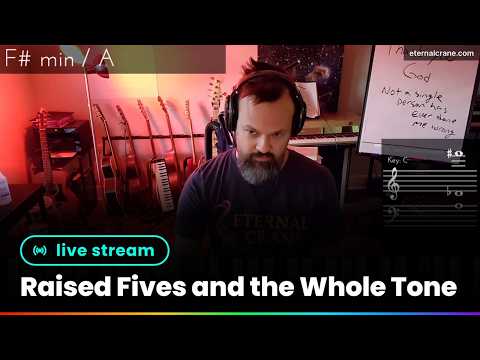 23mRaised Fives and the Whole ToneEternal Crane
 33mThere Will Be Flowers Next YearEternal Crane
 22mShou Yi 守一Eternal Crane
 24mBlue Falling Ice GlaciersEternal Crane
 10mPillars of CreationEternal Crane