

Lesson 9: Every Stranger Belongs
Thirteen Weeks of Music & Spirit · Lesson 9
The ninth lesson of Thirteen Weeks of Music & Spirit, opening its fifth week. Its theme is Every Stranger Belongs: how we welcome the stranger, and how we are guests ourselves. joEy is about to be a new stranger at a church himself, so the teacher is becoming the student.
Rumi visits first, and joEy reads him: the body is a guest house, and whatever comes into the heart from the invisible world is a guest. We are guests in other people's churches, businesses and families. Everything comes from that invisible source, the musical divine signal too, so we can be good guests to ourselves and to the life we receive.
Eight short teachings on welcome come up on screen as he plays: the guest within, fellow sufferers, the holy guest, no one cast away, and you belong. Of Hebrews' angels unawares he says, "I'm learning with you." Reading Lao Tzu, he underlines the word any: we love to add an asterisk, any person except, and we shouldn't.
He closes by asking us to open our hearts to others and draw no exceptions. You are a guest house too, receiving your life, so treat your own life as you would want a stranger to treat you.
Quoted on screen, and four of them read aloud: Rumi, Masnavi V 3644 and 3646, translated by R. A. Nicholson; Guru Arjan, Guru Granth Sahib, page 1299, translated by Sant Singh Khalsa; Exodus 23:9, King James Version; Arthur Schopenhauer, Studies in Pessimism, "On the Sufferings of the World", translated by T. Bailey Saunders; the Taittiriya Upanishad, I.11.2, translated by F. Max Müller; Hebrews 13:2, King James Version; Lao Tzu, Tao Te Ching, chapter 27, translated by James Legge; the last card, You Belong, is joEy's own words.
The music is seven colors, seven scale modes on C. A scale mode is simply a set of pitches played as a group, and each has its own musical color. joEy improvises in each, inverting chords in both hands, building little structures like speaking in sentences, and letting any happy appearance ride.
Each color is a seventh chord, and each new one drops a single note a half step. Major, C E G B, sounds warm and bright from its major third and major seventh. Drop the seventh to B flat for dominant, C7, with its melodic flat seventh; drop the third to E flat for minor, where he plays Dorian, with its natural sixth, A.
Drop the fifth to G flat for half diminished, a dark color, and the seventh again, to A, for diminished. Diminished is all minor thirds, so every inversion has the same shape. Over both he plays one scale, the half-whole diminished scale, a half step then a whole step in turn: C, D flat, E flat, E, G flat, G, A, B flat.
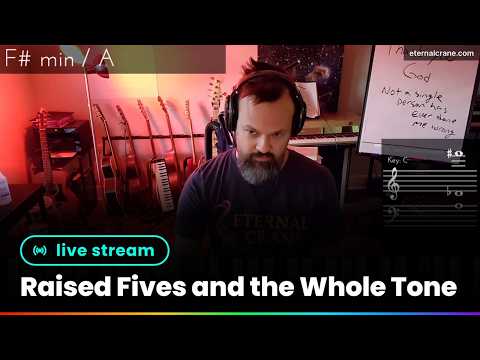
Lydian dominant is the major scale with a raised fourth and a flat seventh, in C an F sharp and a B flat. Its heart is the major third, the tritone and the flat seventh, so don't skip the tritone. Last is the whole-tone scale, all whole steps, C D E F sharp G sharp B flat, a close cousin of Lydian dominant. He plays it in pairs and in thirds, then mixes the intervals until it sounds like wind blowing, like Debussy.
New lessons every Tuesday and Thursday, each with a live study on YouTube at 7pm Central, until the end of the year.
Courses
View all
Studies
View all

Improvs
View all



Joseph Malicke
Pianist, composer and teacher, and the founder of Eternal Crane.
joEy is available for one-on-one sessions: private lessons, work for hire, and private consultation, 45 minutes at a time, in person or online.
He teaches piano, guitar, singing, music theory, songwriting and improvisation, to any age and from any starting point. He can also help you build a studio and make your own records, lead a band, grow your name as a musician, or deepen your spiritual life. Or send him a piece you love, and he’ll learn it and play it for you.