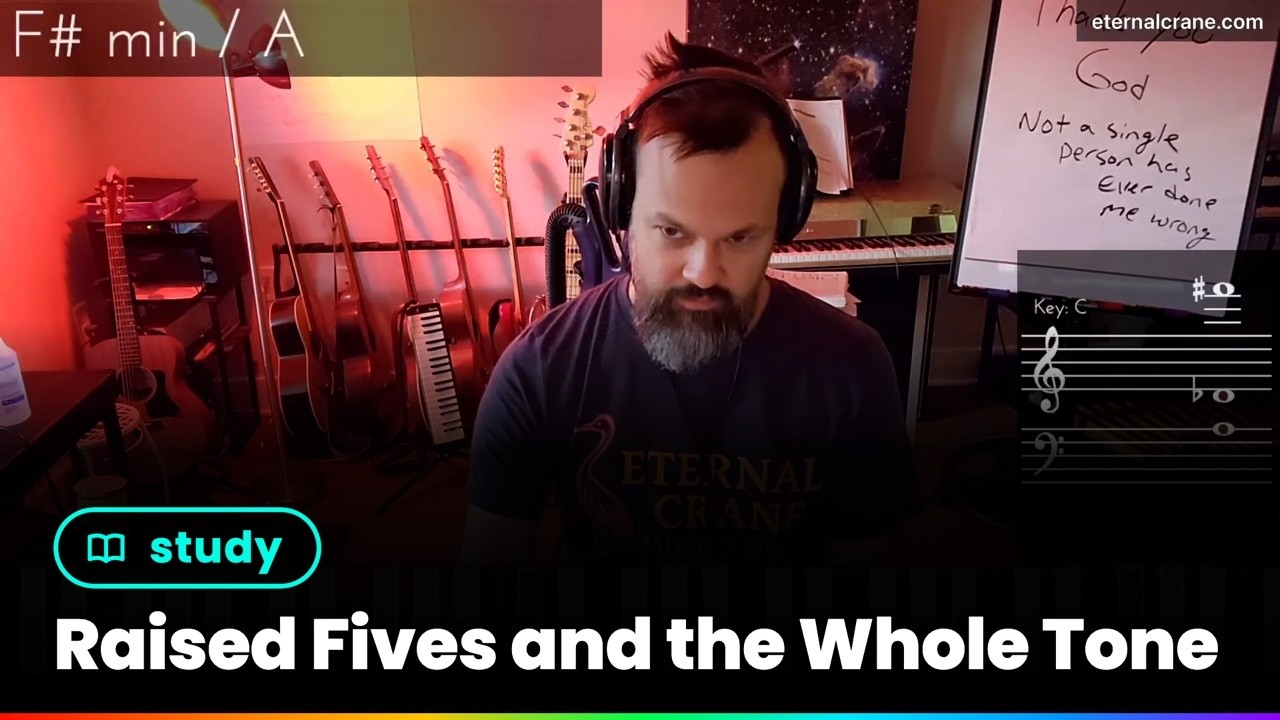
Raised Fives and the Whole Tone
#Augmented chords#Circle of fifths#Intervals#Inversions#Whole tone scale#Happy appearances#Letting go
A study of the augmented triad, a major triad with its fifth raised a half step, like C, E and G sharp. Its notes are evenly spaced, a major third apart, so C, E and G sharp augmented share the same three notes, and the twelve keys make just four augmented triads.
joEy plays each one in every inversion and builds an augmented scale on each, alternating half steps and minor thirds. Then he walks the triads along the whole tone scale, calls intervals vectors because each has a distance and a direction, and turns a chord he found by accident, G augmented under A diminished, into an exercise around the circle of fifths.
Along the way he talks about letting go of what the books call proper. He ends on music as his master: always above him, never finished, with no destination.
Chapters
View allTranscript
Follow along using the transcript: 2,139 words in 7 chapters.
Show transcriptClips
- Intervals Are VectorsFifths and fourths? Intervals are vectors.On YouTube Shorts · On TikTok
- A Happy Appearance in Twelve KeysA mistake is a happy appearance.On YouTube Shorts · On TikTok
- Music Is My MasterI haven't mastered anything at music.On YouTube Shorts · On TikTok
- Trill the Hard IntervalsStruggling with an interval? Trill it.On YouTube Shorts · On TikTok


Ask joEy
A question about this study goes straight to joEy, and it’s always free.
Ask your questionIn this video
- Raised Fives in Every Key
- Exotic to the Western Ear
- Intervals Are Vectors
- Walking the Whole Tone
- A Happy Appearance in Twelve Keys
- Music Is My Master
- The Sweet Spot of Eternal Crane
The words of the whole 42m study; the video is a 23m cut of it.
Raised Fives in Every Key
Okay, so today, I'm just gonna do some raised fives. Gonna do some raised fives. Raise Fives. Raise Fives. So, first thing I'm gonna do, I'm gonna play five for Symmetrically Augmented. A-flat Augmented. The same notes. Four of them. So, basically I took Confuse. Confuse. Diminished and Augmented sometimes. Beginning. Five. That's D. Go one more. Second inversion of C. You technically could go minor third, half. Is.
Exotic to the Western Ear
They consider it exotic. To me, they're both the same. They just, they're different inversions of themselves. To me, there is no proper doesn't exist. So, I try not to remember what is proper and what they teach in a book. I would push that stuff out of my mind.
This. Half-step minor third. Half-step minor. Consider that Augmented over C. Consider it Augmented just another color. It's quite a different color. I think that the ear, probably the international ear, is more used to hearing. Half-step. Half-step minor third version. So, they would say that's Egyptian, possibly. Whereas this one, I think they would still say that. Their ear is less used to hearing the minor third. So, if they heard the minor third, they'd hear the blues.
So, if they hear the minor third, this half-step, it's familiar to the Western ear. Especially because these are the minor. Minor third is the minor scale. Major. I have a scale that has a minor third. The major third would be more confusing for the Western listener. And by Westerner, that's also the international listener. The Western has traveled.
So, I'm going to take one. I'm going to make sure Twiddle's okay. I think they're kids, but I just want to make sure my cat. Twiddle's okay. So, all that leads me to say that the minor second half-step. The half-step minor third standard scale. It's the more familiar one. But I recommend you play both. To the augmented. Scale. Algena. As you learn how to do these calculations on the fly. You learn the distances. The absolute distances.
If you want to just keep it chill at first. Do it like this. Play the triads. Down. My body played version of the C7s. Because I've been doing so many 7th chord, dominant 7th inversions. So, sometimes your body plays just a shape that you remember. But what I meant to play is the augmented. First inversion of C. It's also called E augmented. They're the same.
Start the set again. Let's make them an exercise. I feel them. Listen to what they're... Step. If you can't find it, just go back. I'm struggling to find it. So, I'm going to... Again. Just to say... Just to say... Your third... Stacking.
See, my point is, like, you'll learn... You'll learn to be on any key, F sharp. How do you go down a minor third? You know that it's E-flat. How do you go up a fourth? How do you go down a minor second? It's E. How do you go down a fifth? These are the trickier ones for me. Because I confuse the... Going down... I confuse the fifth and the fourth a lot. Because they're opposite directions. But I'm going to guess... I guess the fourth. See? So, that's something I can improve. But it's actually B.
Intervals Are Vectors
The fifths and the fourths are all messed up. Because going down fourths is the same as going up fifths. So, people say that you should go through the circle. But that doesn't mean anything. And they say that you should move a fifth or a fourth. That doesn't mean anything. It's actually a vector. To take a math term. And a vector is a... It has a direction. As well as a distance. So, intervals are really vectors. So, you need to know which direction you're going to.
And apparently, I don't. When I play fourths and fifths. But, that's how intervals can help you. You can take any note. And then you can find a major third down. You can find a fourth down. So, that helps you build all these. So, if we go back. We're at this one. You don't know how to build this. You just build major third. Major third.
Building intervals can help you. That version. Confused, remember. Go with a major third. For me. My body likes the shape. For some reason. Two times. Say it.
Now you learn. It's fine. joEy method. Step. Played the dominant just for fun. Played a major third. So, I'm going to play.
Oh, I missed this. Inverse it. Go find it again. B major at the end. Did as you did. Twelve. Say it like this. You've done all twelve augmented chords. You did four groups of three. You inverted all of them. You built. Built the. Augmented scale on every. Version. So, now if you're playing. Let's say you're playing in C. You have. Put it on your fingertips. B flat. Got it now.
Mistake. Happy appearance. You can pretty much get away. Get away with it. Because. Listen to this. That's the augmented. Play this. Didn't change fundamentally the sound. So, you can get away with all sorts. You could even play. To. With a tritone. Nobody can really hear it. I can hear that. Most people it's going to be okay. They're just going to hear it as a color. Based off the whole tone.
Walking the Whole Tone
So, if we go back to the whole tone. One, three, five. So, that's another way to study these. It's basically just walking. This is just a gorgeous sound. Does that sound good? Going back down. Down is going to be tricky. Walking down the whole tone. So, what's hard about this. You could say I'm at C. And I want to walk down a whole step to B flat. And you have to calculate the shape. Or you could say I'm walking down from B flat.
So, that's probably easier. So, if we just go whole tone. We're going to go up by the whole tone. And by the way, you can put the root on the top. The four note chord. Or you could just keep it as three. If we just go up the whole tone. Beautiful sound.
Say we're at A flat. So, I'm going to go down to F. So, that's another way of calculating it. It's tricky. I said going down is usually harder. It's basically it. Now, you did all six of that whole tone. And then you would go up a half step. And you'd do it in the other whole tone. Just like that. Those were inversions. Excuse me. Let's go up.
This brain exercise. No difference between exercising and practicing. It's just music. That's another way to do six of the second set. So, we just did all 12. And then you could go this. And then build something in whole tone. This is a little more challenging.
Challenging. Okay. Going. Because we're learning. Step. For the other six. That's a big change. So, I'm going to do it again. So, I'm going to go again. Chord.
A Happy Appearance in Twelve Keys
I want to play a chord like this. Learn how to play it in all 12 keys. I don't know what this chord is. It just kind of appeared. So, this is a great way to take a break. So, you played a random chord you don't understand. It's a quote mistake. It's a happy appearance. Figure out what it is. It's augmented on top. And it's a diminished on top. G augmented on the bottom. And then you go up a whole step. And you play it diminished on top.
Now, your challenge is to do that in all 12 keys. I did that quite quickly. If you're beginning, you might have to figure it out. It could take you 30 minutes to figure out what kind of chord this is. It could take you an hour just to learn to apply it to another key. But once you learn how to apply keys, you basically can do it much more quickly. So, I'm going to say this is in the key of G. We're playing a really funky G chord.
And we're just going to go through the circle. So, I'm going to play augmented on the bottom and diminished on top. There it is. Wow. So, you have all of a sudden you're creating. Try to play F augmented on the bottom and G diminished on top. If you can learn to do this, you can actually start going through the circle.
Starting to have organization happen. The listener does hear. They hear that these are related. They may not understand this particular color. But if you start to move through these. See how I'm just moving through these? If you just move through them. It's striking. Through them with, um, through them.
Music Is My Master
I prefer to say as if you've mastered it. I wouldn't say I've mastered anything at music. Music is my master. Music is always above my head. I'll never understand it and I'll never get to it. And it'll never finish. That's because to me, music is transcendent. So, there's no destination. There's no joEy can play now. It's just, it's a forever process. So, that's why I say the illusion of mastering it. So, I would say the illusion of mastering it is if you can, if you can move quickly, like from A to D to G.
People start to think that you've practiced that. You know, they think that you've intended to do that. That's not the case at all. I just sat here and decided this was a beautiful chord. So, anyways, going all the way back. We were finishing up stuff.
Appearance. I'll do that one again. Because there's black keys. So, it's kind of far away. It's a little different. Third. Third. You see how I trilled? If you're really struggling with an interval, trill. Trill on all of the minor thirds. Going up. Thought I would.
That. Trilled going up before. Don't trill the half steps. That's a way to really get those intervals inside your brain. It's quick. Last one.
The Sweet Spot of Eternal Crane
Just, how long is this lesson? 39 minutes. I guess that's kind of a long time. But we lollygagged a little bit. I showed you a lot. I showed you how to make the augmented scale. I guess I skipped a lot of it. I skipped a lot of the fundamentals. I think that Eternal Crane is not... It is about the fundamentals. But I'm... There's so many places that you can learn how to make the augmented. So, I think there should be prerequisites.
I think I should tell you, go look up how to make the augmented. Or I could do it so quickly. Because there's other resources for you for that. Eternal Crane is really a special sweet spot. It's the spot that nobody else is. There's a million videos you can find where people are constructing scales and details. And they're analyzing this in every single way. But there's not a lot of people... I haven't found anybody doing what I'm doing.
Who will sit down and show you how we go through them. The different ways to go through them. The way to connect them and make them musical. That's really the sweet spot of Eternal Crane. So, I think in the future I can be a little better and I can point you to the really basic chord construction. The real basic, basic, basic stuff that everybody's doing. And then once that's out of the way, you can still watch this video even if you hadn't learned that stuff yet.
And you can still be inspired by what I'm doing. What I'm doing can help you get through those basics. So, we did skip the basics of how to construct it. But other than that, we went through all 12 augmenteds. We went through all four groups of three. We inverted all of them. And we built the augmented scale off every inverted root. We connected it to the whole tone. We did a little bit of improvisation. We took a little bit of lollygagging when I showed you this happy accident. I knew how to do that in 12 keys. So, I think that's a really good lesson.
This may be... This would be something that I could do for Eternal Crane. Like, this would be on the site. And I could do the same thing for diminished. You know, it's augment. I could do the same thing for diminished. Do the same thing for major. Whole dominant. There's a whole philosophy that I have that I've invented myself. It's a different way of playing music. Leave it here.
Up next
 20m
 Lesson 1: One NoteEternal Crane
 1h 17mJapanese MelodicaEternal Crane
 33mThere Will Be Flowers Next YearEternal Crane
 22mShou Yi 守一Eternal Crane
 22mLesson 8: The Husk and the GermEternal Crane
 15mImprovising Seventh Chords Through the KeysEternal Crane
 24mLesson 9: Every Stranger BelongsEternal Crane
 21mLesson 7: The Human Divinity SignalEternal Crane
 23mLesson 5: Not Knowing Anything is the Best Place to BeginEternal Crane
 20mLesson 4: Wrong Notes or Happy AppearancesEternal Crane
 22mLesson 6: The Mountain, 12-Key BluesEternal Crane
 10mPillars of CreationEternal Crane