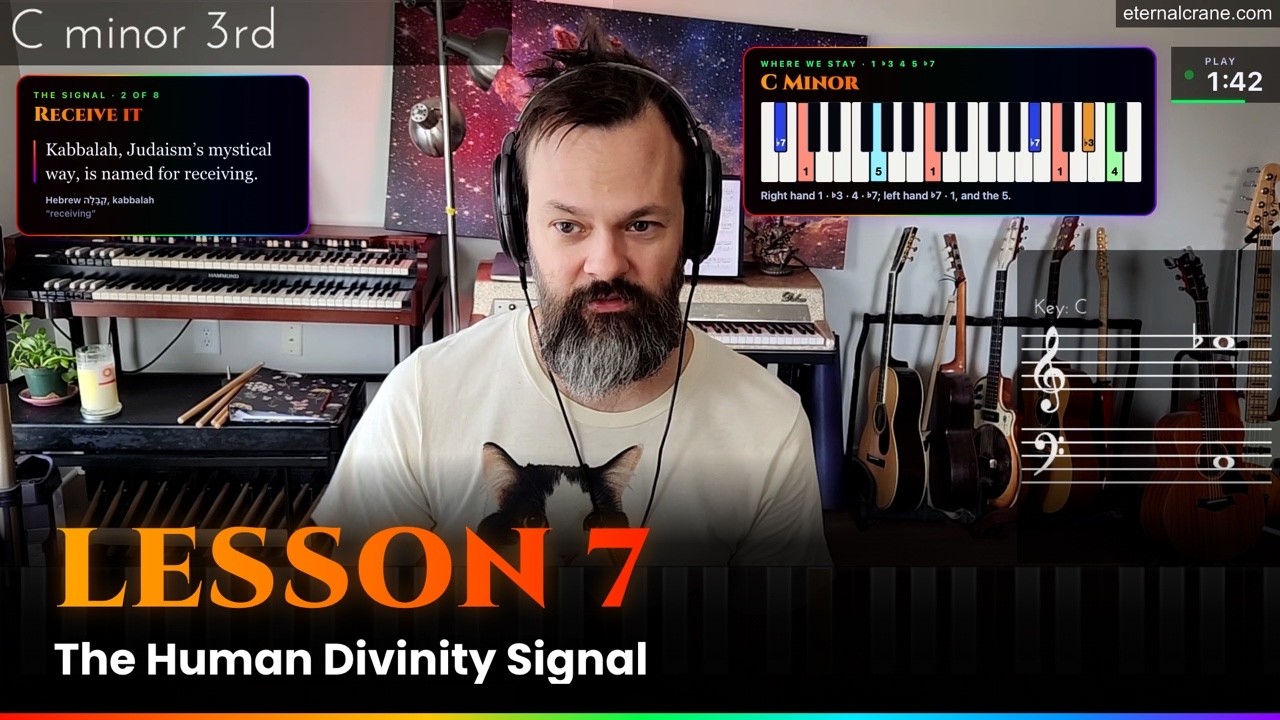
Lesson 7: The Human Divinity Signal
#Call and response#Inversions#Phonological loop#Triads#Tritone#Whole tone scale#Happy appearances#Mindfulness
The seventh lesson of Thirteen Weeks of Music & Spirit. Its theme is the human divinity signal: music is not about accumulating, it is about being in touch with the signal, the musical signal.
The whole lesson is played, and eight short teachings come up on screen as joEy improvises: receive it, live in alignment with it, stay pointed toward it, and let it guide you. Kabbalah, Judaism's mystical way, is named for receiving.
Wind chimes and a gong sound four times a day in joEy's room to remind him of the signal. There are no distractions in music: every sound around you can be part of it, and mistakes are happy appearances.
Quoted on screen, and some of it read aloud: Hazrat Inayat Khan, The Mysticism of Sound and Music, its Prologue (read with "her flute" for "His flute") and chapter XII; Wayne W. Dyer, There's a Spiritual Solution to Every Problem, chapter 3; the Mundaka Upanishad, II.2.4, translated by F. Max Müller; Thomas R. Kelly, A Testament of Devotion, "The Light Within"; Isaiah 30:21, King James Version.
The music is a free improvisation in C minor, made of little structures you remember and repeat. The phonological loop is your brain's short memory for sound: it holds about two seconds of what you hear, so train it by playing a short phrase and playing it back.
joEy's first pattern uses four notes of C minor in the right hand, 1, flat 3, 4 and flat 7 (C, E flat, F and B flat), over flat 7 and 1 in the left (B flat and C), then adds the fifth, G. He builds by repeating and changing: the left hand walks down C, B flat, G and F, a major third (E) slips in, and he lets major and minor live together. A wrong note, an A flat, becomes a walk down the whole-tone scale back to the root.
A call and response is a phrase played three times and answered the fourth, as in the blues. Then the four chord: over E flat and B flat in the left hand he plays the F major triad and its inversions, F A C, A C F and C F A. Last he stays on a dissonance, the tritone F sharp against C, before closing with the whole structure.
Sheet music
This lesson’s music, written out: free to download and print with a free account.
Download the PDFthe-human-divinity-signal.pdf · 248 KB
Chapters
View allTranscript
Follow along using the transcript: 1,704 words in 7 chapters.
Show transcriptAsk joEy
A question about this lesson goes straight to joEy, and it’s always free.
Ask your questionIn this video
- 0:00:12The Human Signal
- 0:01:28Train Your Phonological Loop
- 0:02:36Receive It
- 0:05:43Little Structures
- 0:11:18Call and Response
- 0:17:36Stay on the Dissonance
- 0:19:11The Whole Structure
The Human Signal
0:00:12 Hey, what's going on? It's joEy from Eternal Crane. Thanks for coming by. We're continuing on 13 weeks of music and spirit. This is lesson seven. So we're in week four. We're going to do free improvisation today. And I'm going to tell you some tips about composing on the fly. As that's happening, we're going to read about the human signal, about the divine signal. It's not about accumulation. It's about being in touch with the signal, the musical signal. I'm starting with C minor. Just going through one, flat three, four, flat seven. Left hand is flat seven, one. So making an improvisation. It's helpful to use your phonological loop. Everybody has a little tape machine in their brain that's recording.
Train Your Phonological Loop
0:01:28 And most people can recall a couple seconds. You can train your phonological loop to recall what you've played. So try that if you're beginning. Try to train your phonological loop. C minor. Let's say that's the first pattern. I trained my phonological loop. I didn't know I was going to play that until I played it. And my phonological loop allowed me to repeat it. So that's the first tip I want to give you is work on your phonological loop. Remember what you're playing when you're improvising.
Receive It
0:02:36 Let's build from here. I'm going to keep that right hand pattern. And in the left hand, I just went to a flat seven. I'm just adding the fifth. Receive it. Kabbalah, Judaism's mystical way, is named for receiving. Receive your improvisations. This time I'm just going down left hand. So that's one, flat seven, five, four, one. I played this G note. Let's receive that. So play that G. And I'm going to go into something else. Phonological loop. Remembered. The right hand pattern is basically four, five, flat seven, one. You hear the chimes in the background. These play four times a day for me.
0:04:24 And they remind me to be in touch with the human signal. The divine signal. So phonological loop. We're in C minor. It remembered that we did this. It remembered that we descended in the left hand. That may be enough for you. That may be your journey for today. And that's a great spot.
0:04:58 Now I'm going to keep going. I remembered this G that I played. I'm just repeating the shapes. Now I played a C inversion. Let's talk about the left hand there. Flat seven, one, flat seven, five, four. Trilling on the major third. That's technically a dominant. I'm playing C minor inversion.
Little Structures
0:05:43 So when you're improvising, it's great to create little structures. This is a structure. Hold the structure. Play the second structure. Notice that I ended on a major. So we started with minor, but we ended on major. That's okay. You don't have to choose major or minor. You can, you can be in all of them at the same time. Music is about freedom. Play with your surroundings. If there's chimes, play with the chimes. So that just came out of my soul. I don't know where that came from. The right hand. I'm inverting. Those environment sounds soothe your soul. When you play, you connect with your entire universe. There's no distractions. So what came out? Major three, four, one, flat seven, one.
0:07:50 The right hand is just going through the triad inversions. Repeating it. Using my phonological loop. Hear how I repeated the right hand? The third time I started on the fourth. Your loop will learn. It'll learn if you start on the third or the fourth. The more you train it, it could start on the fifth. Don't control it, though, while you're playing. Just let it happen. This was a happy appearance. We call mistakes happy appearances. I ended up playing an A flat. So let's go with that. Turning it into a whole tone and ending on that flat seven. Going back. So what happened there is I made a quote mistake. Happy appearance. Ended up just walking down a whole tone scale so I could get back to the root. Okay? We've been skipping our quotes. Oops. Back to the original. The audience likes it. The listener likes it. When you repeat the structures and you're welcome to compose and write it down in your book. This is a piece. There's no different. There's no differences
0:10:27 from this to some Grammy song that you hear on the radio or television. Om is the bow. The self is the arrow. Brahman is called its aim. That's radical. These are teaching me. Well, I'm teaching you. Oh, so this is quite beautiful. Wow. This is just the C inversion down. This is technically the first inversion and the left hand is a minor seven. That's just wonderful. So repeat the structure for your listener.
Call and Response
0:11:18 You're welcome to play this improvisation with me and you're welcome to write your own. Those are just three C major inversions. See how I allow myself to go minor, but I'm not fixated myself to play a major when it comes out of my heart. This time I ended in a high G. So that's something that's helpful when you make these structures. For example, this one that's back from that dominant major three, four, one, flat seven, one. I'm going to do it three times. And the fourth time, I'm going to give you something different. So that's a common pattern. That's a blues pattern, call and response.
0:12:33 It can be twice, once, twice, and it can be the third time. I still call and response blues, but there's many blues forms that do it four times. And the fourth time is the answer. So it's up to you. You can also, you can also do it three, fourth. That gives you, you're commenting on yourself. You're, you're reacting to your own playing. Thomas R. Kelly from A Testament of Devotion. I've never heard that. Stay pointed. Deep within us. There is an amazing inner sanctuary of the soul, a speaking voice to which we may continuously return. Music is the eternal return. So when you call and answer, you're speaking to yourself, you're referencing yourself, and you're also speaking with the listener. This is the three and the fourth. This time had a little trill. So you can see how I'm building these little call and responses. I'm letting myself be a little free. We've done a lot of teaching. I just want to show you some more things. I'm just listening. It's just a little
0:14:39 statement ending on the fifth. It's nice to end on the fifth, the third, or the root. Once you get practiced and see that you just can let these flow from your heart. This is a minor three. So E flat is the minor three of C. I just put a fifth on top and then I played a four chord. I wasn't thinking this is a B flat major nine sus four over E flat. I was thinking, let's get into some of these beautiful minor colors. So I picked the left hand to build a first and a fifth off the minor three, but I wanted to stay in C. My heart was saying, stay here, allow some of these major colors. So that's why I played a four chord, which is just the F triad. And it's nice to invert it. Now this you could also put in your phonological loop. I'm just repeating. I'm training myself to remember what I've played without controlling the moment and keep moving. I'm just putting new bass, new bass lines. I'm just walking down the C
0:16:36 minor. I'm going to play tritone just to mix it up. It's very dissonant. Practice letting yourself stay on dissonance. This time I built an F sharp major over what was the left hand. I think it was either F or C. So it's not so important when you're just listening and you're just allowing that signal to flow through you. The way that we got there as I was doing this very beautiful phonological loop that will be on the test tomorrow. Professor joEy says study for that. I went to the F sharp, which is not diatonic, the C minor.
Stay on the Dissonance
0:17:36 And I pointed out that it's a dissonance. Why did I go there? Because I wanted to hear it. That's all. Because it was speaking to me. And then the habit I want you to learn is when you're on a dissonant. A lot of, especially beginners, but most musicians, they want to run away from the dissonances. Discord. It guides you. I have become his flute. I'm going to put her in there. I have become her flute. And when she chooses, she plays her music. That's a little shout out to Saraswati who's sitting on my electric piano. So let yourself enjoy those dissonances. And if you play something different, let it flow. No need to even do anything with it. You can repeat your happy appearances or you can just let them go. So here, because the dissonant, I'm just letting it, letting it be here. And then I built a triad. This is a cluster chord on top. But the first time I built a triad on the dissonant note.
The Whole Structure
0:19:11 So I'm going to wrap this up. My gong is going. Every four times a day, I have the chimes and then I have the gong. The gong is telling me this is it for today. I wish I could go on. I'm going to close with a little improvisation. I just want to show you the whole structure. Testing my phonological loop.
0:20:51 That's the improvisation. Thank you. Much love to you. Send me questions. Eternalcrane.com. Join the discord. Share your own little improvisation with the community. We'd be happy to listen to it. Continue with this course. It goes until the end of the year. Every Tuesday and Thursday, there will be lessons on the holidays. Every day is a holiday at Eternal Crane. There's no difference to us. You're welcome to hire me too. So with that, may you find that this human divine signal.
Thirteen Weeks of Music & Spirit Eternal Crane · 7 / 9
- 1
 20mOne NoteOctober 6, 2026
- 2
 17mLet Music Play YouOctober 8, 2026
- 3
 19mLive an Empty Life, Discovering LydianOctober 13, 2026
- 4
 20mWrong Notes or Happy AppearancesOctober 15, 2026
- 5
 23mNot Knowing Anything is the Best Place to BeginOctober 20, 2026
- 6
 22mThe Mountain, 12-Key BluesOctober 22, 2026
 21mThe Human Divinity SignalOctober 27, 2026
- 8
 22mThe Husk and the GermOctober 29, 2026
- 9
 24mEvery Stranger BelongsNovember 3, 2026
Up next
- 22m
 Lesson 8: The Husk and the GermEternal Crane
- 24mLesson 9: Every Stranger BelongsEternal Crane
 23mRaised Fives and the Whole ToneEternal Crane
 22mShou Yi 守一Eternal Crane
 1h 17mJapanese MelodicaEternal Crane
 24mBlue Falling Ice GlaciersEternal Crane
 33mThere Will Be Flowers Next YearEternal Crane
 15mImprovising Seventh Chords Through the KeysEternal Crane
 10mPillars of CreationEternal Crane