Chapters
- 0:00:11Welcome: One Lesson a Week
- 0:01:33The Dominant's Tritone
- 0:04:33The Restless Heart
- 0:08:44Hang Out on the Dominant
- 0:11:46Another Hole Appears
- 0:12:52Treat the Tonic as a Dominant
- 0:16:46Find Something Unresolved
- 0:20:42Linger, and Don't Move
- 0:22:42Every Inversion of the Dominant
- 0:27:37A Constant Return to the Keynote
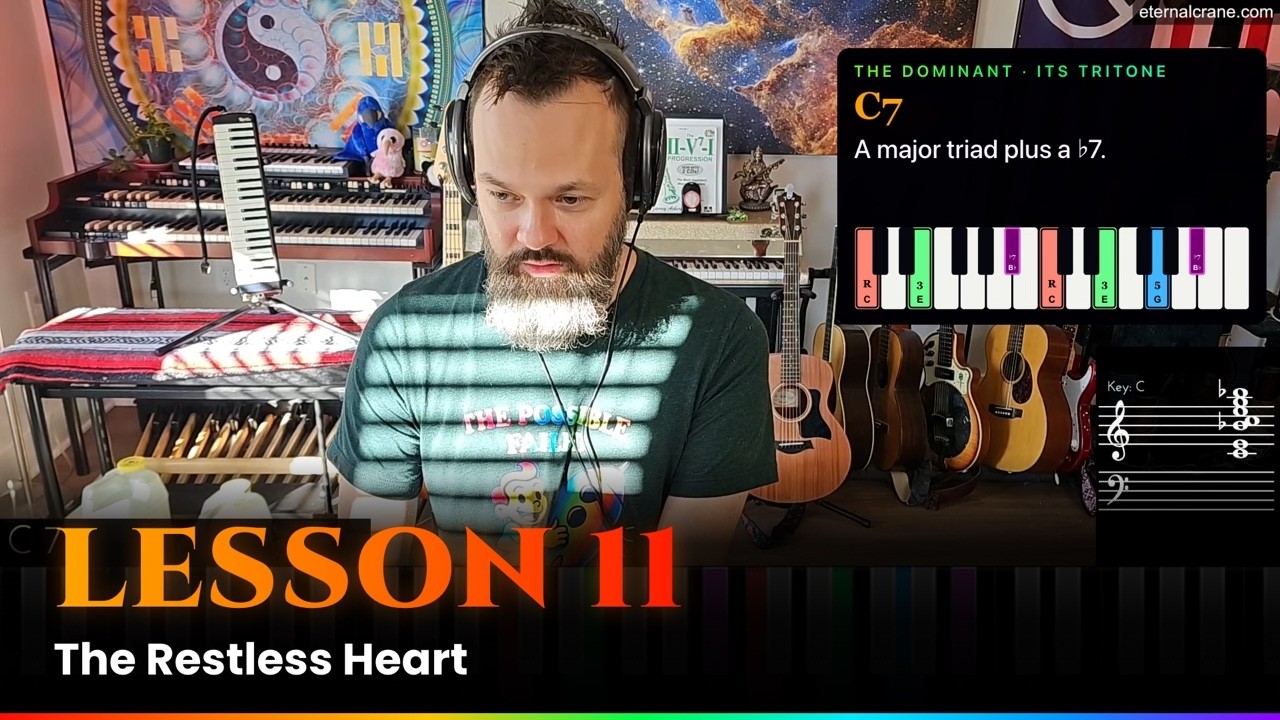
Lesson 11: The Restless Heart

#Circle of fifths#Half steps#Inversions#Seventh chords#Tension and release#Tritone#Emptiness#Letting go#Tao Te Ching
joEy opens with his heart: an empty bucket with a hole in the bottom. Grace pours in and runs straight out.
For years he tried to fill it. At 39, he's letting it leak. Augustine said our heart is restless until it rests in God, and joEy's answer is to stop fighting the restlessness: "Don't try to have an empty bucket. And don't try to plug your leaks."
Schopenhauer, C. S. Lewis, Chuang Tzu and Lao Tzu come along on screen.
Quoted on screen, and read aloud where he reads them: Augustine, Confessions I.1, translated by E. B. Pusey; Arthur Schopenhauer, The World as Will and Idea, §§ 29, 38, 52, 57 and 58, translated by R. B. Haldane and J. Kemp; Sigmund Freud, Beyond the Pleasure Principle, translated by C. J. M. Hubback; C. S. Lewis, Mere Christianity, Book III, chapter 10, "Hope"; Chuang Tzu, chapter IV, "Man among Men", translated by Herbert A. Giles; Lao Tzu, Tao Te Ching, chapters 11 and 46, translated by James Legge. The fifth card, Another Hole, is joEy's own words.
Then the piano says it better. The dominant chord holds a tension that wants to resolve, and joEy asks you to stay in it: "Just as you're about to move, don't." He walks it round all twelve keys, and hands it over: "So go through all your inversions. You can do it."
Ask joEy
A question about this lesson goes straight to joEy, and it’s always free.
Ask your questionIn this video
- 0:00:11Welcome: One Lesson a Week
- 0:01:33The Dominant's Tritone
- 0:04:33The Restless Heart
- 0:08:44Hang Out on the Dominant
- 0:11:46Another Hole Appears
- 0:12:52Treat the Tonic as a Dominant
- 0:16:46Find Something Unresolved
- 0:20:42Linger, and Don't Move
- 0:22:42Every Inversion of the Dominant
- 0:27:37A Constant Return to the Keynote
Welcome: One Lesson a Week
0:00:11 Hey, it's joEy from Eternal Crane. This is 13 weeks of music and spirit. It's week 11, the restless heart. The music is the dominant chord. And a little note keeping, I am reducing the course down to 13 weeks, one lesson a week. So I did 5 weeks with 2 lessons. That comes out to 10 lessons. And less is more. And this will allow joEy to stay in the long game. So the course is now 13 lessons total. So this is, we're going to call it week 11.
0:01:13 And it's going to work out just fine for all the people who come and watch the video later, which is the majority of people. So this is the 11th week, the 11th lesson. Thanks for being around. This is the restless heart and the dominant chord.
The Dominant's Tritone
0:01:33 The first thing that I notice about the dominant chord is it has a tritone in it. And this tritone wants to resolve. So let's pick G. Find a tritone. The top note wants to resolve down a half step. And the bottom note wants to resolve up a half step. So this whole movement, as simple as that is, is the primary building block of all Western music. It's a tritone resolution, a dominant chord resolution. And this, we would say, is away from home.
0:02:37 This is tense. And it wants to move somewhere. And it wants to move to the simplest place where it can rest, which is a major third. Here's a C7. And it wants to rest. Just walk down the scale. So it's the dominant tonic relation. So whichever chord is the dominant, is the V chord. I'm just inverting it. It wants to end a descending fifth away. So C7 wants to resolve to F. F7 resolves to Bb. And you can just go all the way through. And you get quite a musical sound. This time I just ended a whole step above my target. Ended on C. It's too little.
The Restless Heart
0:04:33 So the talk is the restless heart. Thou madest us for Thyself. And our heart is restless until it repose in Thee. So I chose this one because I deal with a bottomless heart. My heart is an empty bucket with a hole at the bottom. And there is a lot of grace and water flowing through my bucket. But it just goes right out the bottom. And I've spent a lot of time in life believing and searching and speaking with people and reading books that you can fill the bottom of your bucket.
0:05:20 I do not think it can be done. Or at least I cannot do it. My bucket, I am accepting now. I'm 39 years old. I'm accepting that the bucket will forever be leaky. It'll always ever have a hole in the bottom. And it'll always have to be filled. And what helps is to not try to fill your bucket anymore. Sounds a little counterintuitive, right? Don't try to have an empty bucket. And don't try to plug your leaks. Rather than that, see yourself like a Confucianist.
0:06:07 The sun is here to shine on the earth. It doesn't ask anything in return from the earth. And you are leaking your water. You have a hole in your soul. You have a hole in your heart. And there's some purpose for that. And it's not you. Because if it was for you, you would just make it go away, right? There are things in our life that there are no solutions. There's a tension that cannot be resolved. It's about learning to stay with that.
0:06:42 Feel the tension even more. Feel how the bucket is empty at the bottom that you keep running out. That's a helpful observation to make. This is from Arthur Schopenhauer. Freedom from all aim, from all limits, belongs to the nature of the will, which is an endless striving. See, once you can see that your bucket is empty and that you'll never fill it, then you no longer have to partake in this endless striving, this endless search.
0:07:17 And you can accept the universe for what it is. You can accept your soul for what it is. You can accept its lamenting, its torture, its sorrow. This isn't necessarily happy land, but you can find happiness through it. Happiness is the way, even in your suffering.
0:07:42 So it's about becoming comfortable with that and applying that to music. Get comfortable, get comfortable with these tritones. These are the tritones from C Dominant. Practice them. Just go down. I'm going down by whole steps. And then I'm going to do in D flat dominant. Find the tritone. Just keep going down by whole steps. Get used to this unresolved feeling and learn to play with it. Learn to dance with it. Give them a hint. Go back.
Hang Out on the Dominant
0:08:44 This is why the whole tone is so nice. So a great way to work on your playing is to really hang out on this dominant chord. So I'm at C Dominant and I want to move. I'll show you the tritones. This is the tritone in C Dominant. I'll show you G Dominant. Here's the tritone. The tritone is unresolved. And just like in our life, we want to resolve it quickly. We want the top to go down a half step and the bottom to go up a half step.
0:09:39 This is the closest place that that tritone can resolve. And something this simple is the foundation of virtually all of Western music. This is called the dominant-tonic relation. The dominant chord falls by a fifth to its tonic. So in the key of G, the V chord is the dominant chord. It's C dominant. It wants to descend a fifth and fall down to F. You can make F a dominant chord. And it's going to be the V chord of B flat.
0:10:39 So F dominant wants to resolve to B flat. You can keep moving. This time I'm going to walk. Just walking down the dominant-tonic relation. Adding a little bit of a bounce. It's me just bouncing on a couple notes. You can see how you can go through all 12 keys because it wants to descend. It wants to descend a fifth below. So you can easily move through the circle.
Another Hole Appears
0:11:46 This is my quilt. And I said this today. It cannot be fulfilled. It can only fulfill itself, first of all. Second, once fulfilled, another hole appears. That's my experience of life. And that's what makes life forever moving, forever changing, forever breathing. It's getting comfortable with that inhale and that outhale. Having the rug pulled beneath you. It's all different every time. You can never step in the same river twice.
0:12:22 I taught you the dominant chord. How it resolves a fifth. Just inverting in the right hand. And if you do it in the right hand, do it in the left hand. This is a helpful way to help you have more tension in your playing.
Treat the Tonic as a Dominant
0:12:52 Treat the tonic as a dominant chord. So take the one chord. Let's say I'm in the key of C. Just take the key of C and make it a dominant. If you start playing like that, you already have the tritone inside your chord. So it naturally wants to resolve.
0:13:32 See how I played a minor seven off F? And that suggests the F dominant chord. Just inverting it. If you add that flat seven, you're going to get a lot of natural tension. Wherever you are. This time I play Lydian. Down. Spend more time on the dominant chord.
0:14:20 Enjoy that flat seven. That'll help you. Just some of these inversions. I'm just resolving it by walking down. If you make the dominant your home, you'll naturally have this breathing in your playing. You can very easily change a key just by dropping a fifth. So you naturally can move around the circle.
0:15:32 B, I played a B dominant. See how easily that went to E? Very easily went to A. I'm just adding a little swing. And some of them I'm inverting. You can see just how much you can get out of moving through the dominant chord.
0:16:27 If I find in myself a desire which no experience in this world can satisfy, the most probable explanation is that I was made for another world. C.S. Lewis.
Find Something Unresolved
0:16:46 So if you're playing something, find something that's really unresolved in your life. Find something unresolved in the piano. Learn to dance with it. Don't try to resolve it so quickly. See, music can teach us about our life. If you listen to these, by the way, I just picked a triad and I picked two random notes. If you just listen to these, you start to realize this is no better and no worse than resolution. What is a resolution if not for a place it could come from?
0:17:38 How would you know that you're resolved if you didn't have suspense? Sometimes you think what is unresolved is just another way. Constant resolution. If you just stop and listen to this. John Cage. Read about the philosophy of John Cage. He was a kook who would hang empty paintings on his wall. He wrote the piece four minutes and 33 seconds of silence. Listen to any sound and ask yourself, why don't I like this? What's different about it?
0:18:37 You'll come to find that there's no reason. There's no reason and there's no difference between any of these sounds. They're all just vibration. They all have the same equanimity. They all belong to the collection of sounds. The family of sounds. So become comfortable with sounds that you don't understand right away. And you'll come to understand them the same way as you do the consonant sounds. Probably earthly pleasures were never meant to satisfy it, but only to arouse it, to suggest the real thing.
0:19:18 So most Western ears are very comfortable with these majors and maybe a little dominant, right? They're comfortable with a 1-4-1 and then a dominant and a resolution. But try to do some more. I just built two triads a half step apart. See in another culture, this is the augmented, which is the root of many scales across the world. So you may think that this is dissonant and it doesn't belong. Just like in your life, something is not resolved and you don't think it should belong that way until you discover some other wisdom. You can see it was actually all part of music the entire time. I'm just going through this augmented.
Linger, and Don't Move
0:20:42 A great way for Western ears to start getting into these dissonant sounds is to linger. Linger on this dominant chord because it has that tritone. And just as you're about to move, don't. Keep that tritone. See how I played with it? I let it sit for a while. That's what I have to do. I need to work on my Chinese. You hear not with the ears, but with the mind. Not with the mind, but with your soul.
0:21:35 So even when I play these, I'm not thinking dominant. I'm just, I'm just letting it ring. Some of these are darker. Play with these dominant sounds. I just switch to minor. You don't have to be stuck on one color. You can play a dominant and you can play minor in the left hand. You don't have to be so boxed in. See, actually, this first time I played dominant. The second time I played minor. You can almost squeak it by.
Every Inversion of the Dominant
0:22:42 I just like to go through these and go through the inversions. They're so beautiful. Especially the second, the second inversion. So just go through all of them. See, I'm going through every inversion of the dominant. This is F. Walk down to the descending fifth. If you run out of keys, just move your hand an octave below. Walk down to a descending fifth. This is the best way to learn the dominants. You can go faster if you want.
0:23:39 We'll skip the inversions. So let's keep going. The second time I actually decided to play it that way on purpose. Because I don't get to hear that sound very much. So go through all your inversions. You can do it. I swear you can do it. They're actually not that hard. Listen to the unresolved tension in all of them.
0:24:43 Clay is fashioned into vessels, but it is on their empty hollowness that their use depends. Letting the tension go. Tension is just tension. It doesn't mean that it won't resolve. If you black out, just come back to the room. Take your time. Give those a try. Take your time when you're going through all 12 of them. Play them with a little bit of rhythm. Fun.
0:25:58 It's kind of got a New Orleans. So I'll do a little improvisation on some of these. Just the left hand ending on the third in the right hand. Did a little bit of repeat. All dominant. Do you see how I play this dominant? This is the five chord, the dominant five. I just played just the tritone.
0:26:51 Sometimes less is more. Just play the tritone. That would be a good exercise. So you would do that in F. So you've got to find that F tritone. So play the dominant and then find the tritone. And then where does it resolve? To B. Technically this is Mixolydian.
A Constant Return to the Keynote
0:27:37 The nature of melody is a constant digression and deviation from the keynote. Yet there always follows a constant return to the keynote. Arthur Schopenhauer loved music. So you can always depart and come back. So in your life, trust that whatever tension and chaos you're in, it's just to make the rest of the music sweeter. Now it can be hard to do that sometimes. But you can do it. Think of a time you've done that before.
0:28:36 You can learn these dominants. Be able to easily move through keys. Does that sound good? Capisce? I always want to say capisce. I'm just going through the circle on these. So I hope that's helpful for you today. Do one more.
0:29:19 We keep the Sabbath of the penal servitude of willing. The wheel of Ixion stands still. I have no idea what that means. So I am going to watch this back. I'm going to look that one up. So please enjoy your dominant chords and let me know if you have any questions. And that's it. I'll see you later.
Thirteen Weeks of Music & Spirit Eternal Crane · 11 / 12
- 1
 20mOne NoteOctober 6, 2026
- 2
 17mLet Music Play YouOctober 8, 2026
- 3
 19mLive an Empty Life, Discovering LydianOctober 13, 2026
- 4
 20mWrong Notes or Happy AppearancesOctober 15, 2026
- 5
 23mNot Knowing Anything is the Best Place to BeginOctober 20, 2026
- 6
 22mThe Mountain, 12-Key BluesOctober 22, 2026
- 7
 21mThe Human Divinity SignalOctober 27, 2026
- 8
 22mThe Husk and the GermOctober 29, 2026
- 9
 24mEvery Stranger BelongsNovember 3, 2026
- 10
 36mGrace in Every InversionNovember 5, 2026
 29mThe Restless HeartNovember 12, 2026
- 12
 20mThe Useless Tree (for Albert Ayler)November 19, 2026